Why the intake manifold?
As Greg Raven notes in the Water-Cooled VW Performance Handbook, the intake manifold is the single biggest restriction in the intake system. On the flow bench, a Stage 1 ported A1 manifold flows 10% more air than a stock one.
Porting also evens out the flow between runners. A stock A1 manifold flows noticeably differently from port to port. That matters on CIS: the system can only meter fuel for all cylinders together, not for each one, so evenly fed cylinders run closer to the ideal mixture.
Stage 1: controlled dyno test
A fellow VWVortex member was offered a ported manifold in exchange for a full chassis-dyno run before and after installation, with results shared with the community. The rules were strict:
- Same shop and same dyno for both runs
- No other changes between runs except the manifold, not even an oil change
Test car
- Car
- VW Rabbit with 1984 GTI engine
- Engine code
- JH: 1.8 8-valve, solid lifters
- Valves
- 40 mm intake / 36–38 mm exhaust
- Head
- Ported and polished
- Cam
- 1.6 gas cam (milder than the Euro G-grind)
- Exhaust
- Dual-outlet manifold, 2.25" TT cat-back
- Throttle body
- Stock A1 small-bore
- Factory rating
- 90 crank hp (≈ 78 whp)
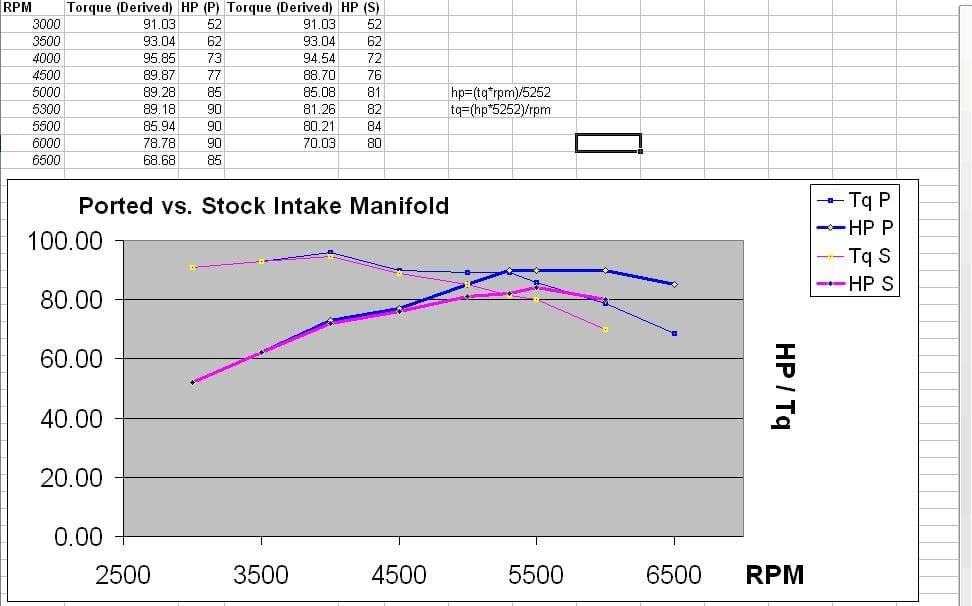
Stage 1 ported vs. stock manifold: wheel horsepower and torque
- HP, ported
- HP, stock
- Torque, ported
- Torque, stock
View data table
| RPM | HP, ported | HP, stock | Torque, ported | Torque, stock |
|---|---|---|---|---|
| 3,000 | 52 | 52 | 91.03 | 91.03 |
| 3,500 | 62 | 62 | 93.04 | 93.04 |
| 4,000 | 73 | 72 | 95.85 | 94.54 |
| 4,500 | 77 | 76 | 89.87 | 88.7 |
| 5,000 | 85 | 81 | 89.28 | 85.08 |
| 5,300 | 90 | 82 | 89.18 | 81.26 |
| 5,500 | 90 | 84 | 85.94 | 80.21 |
| 6,000 | 90 | 80 | 78.78 | 70.03 |
| 6,500 | 85 | – | 68.68 | – |
The ported manifold made 6 more wheel horsepower and 1.3 lb·ft more torque. It also made power earlier in the rev range and kept pulling toward the 6,800 rpm redline, where the stock manifold had already run out of breath.
Stage 3: racing and boost
Further development produced a Stage 3 manifold that flows 25% more air than stock. That took about three times the work of Stage 1. It still looks stock and meets SCCA GP/FP racing rules.
| Stage | Flow vs. stock | Preparation | Intended use |
|---|---|---|---|
| Stage 1 | +10% | Gasket port-matched, balanced flow | Street, naturally aspirated |
| Stage 3 | +25% | Gasket port-matched, balanced flow, welded and reshaped | Racing and boosted engines |
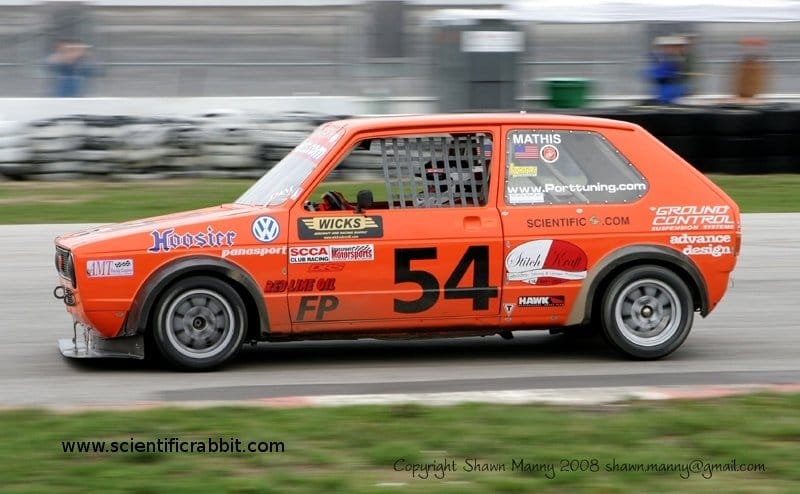
Mathis Racing: SCCA GP Rabbit
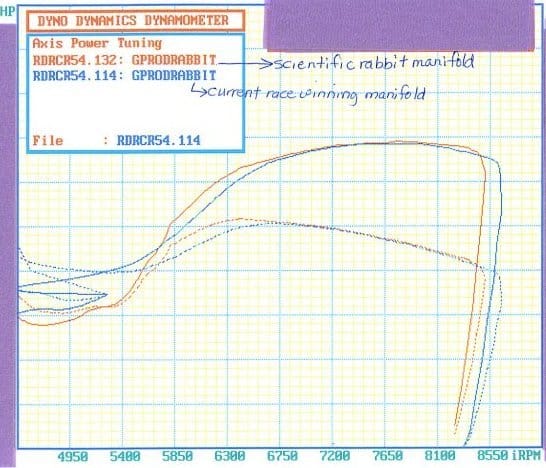
Chuck Mathis Racing wanted more power from their already winning SCCA GP Rabbit, so a Stage 3 manifold went onto the race engine. The ports didn't exactly match the race head, but it still out-pulled the previous season's race-winning manifold. Mathis then ordered a Stage 3 manifold matched to the race head and ran it at the 2007 National Runoffs, finishing second.
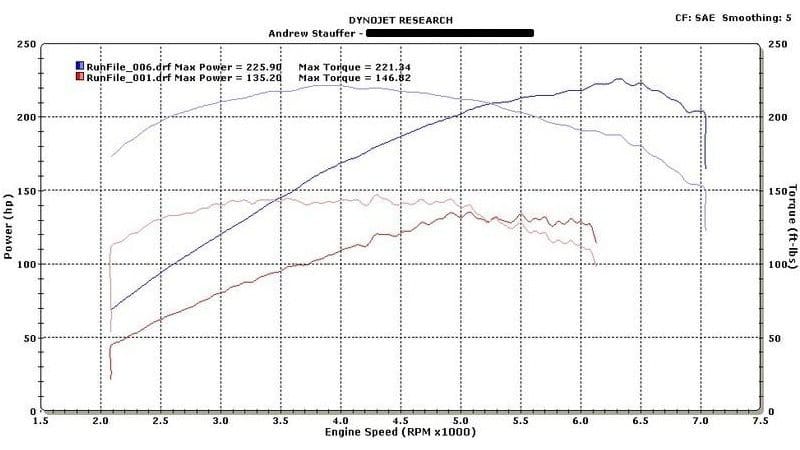
Supercharged Rabbit: past 200 whp
A Rabbit owner chasing 200 wheel horsepower on a supercharger added a Stage 3 manifold to make the most of the boost. The combination: 2.0 ABA block, Euro-spec head with stock valves, MegaSquirt, a Lysholm twin-screw supercharger at high boost with lightweight pulleys, a performance cam, the Stage 3 manifold and a lot of tuning.